SUMMER 2013 | MARINE TECHNICIAN TODAY
7
#
1
#
2
#
3
#
4
#
9
#
8
#
7
#
6
#
5
#
10
#
11
#
12
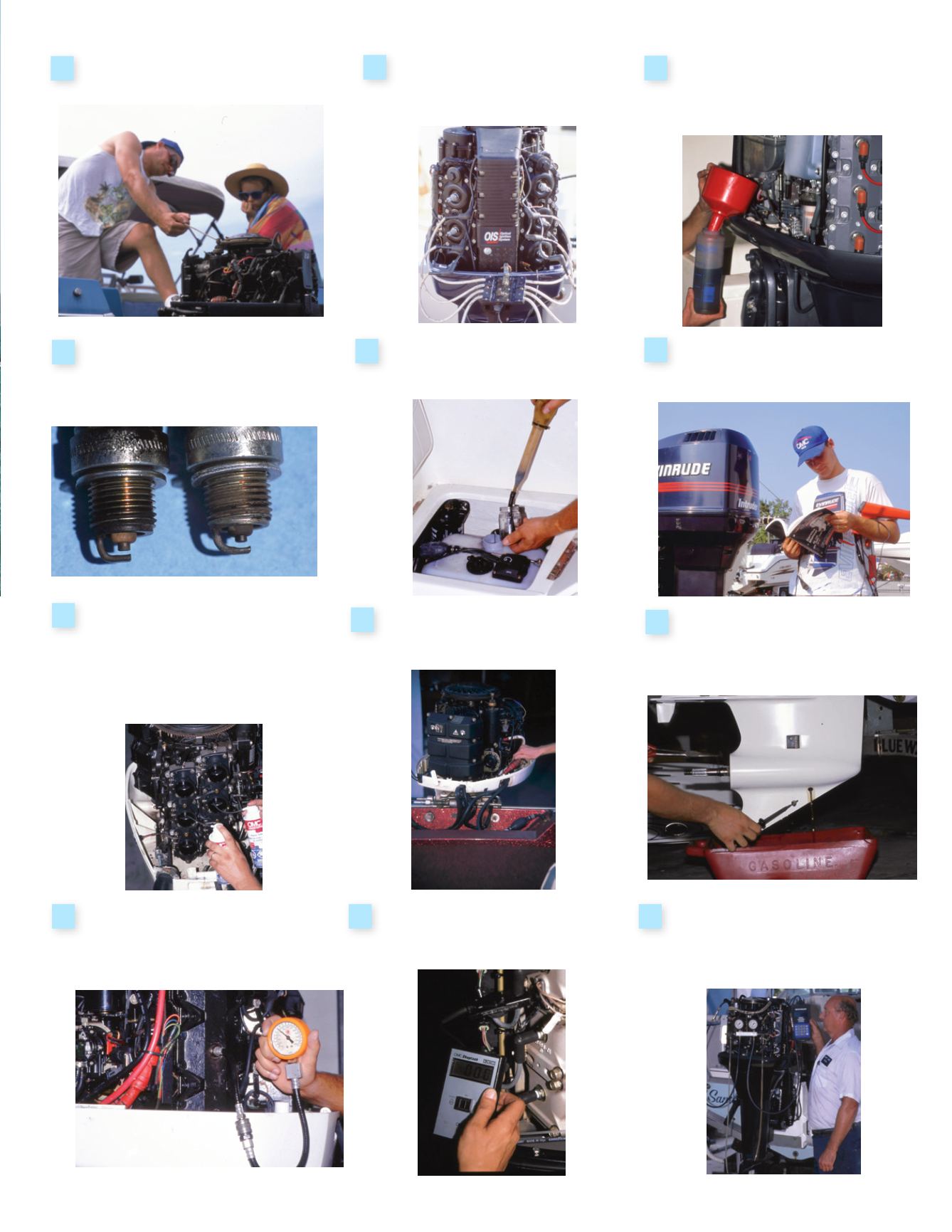
Proper special tools and correct servicing procedures
combinedwith product knowledge allows a
technician to quickly and accurately diagnose and
repair an engine correctly the first time.
Remove the prop to inspect for any
fishing line wrapped around the shaft
and for seal damage while changing the
gearcase lubricant.
Before starting work on the engine have the
proper service literature and tools at hand
for better productivity and efficiency.
Take a gasoline sample from either the
carburetors or the vapor separator tank
to check for stale fuel, water, or dirt in
the system.
A shop tachometer is more accurate than the
boat’s tach for critical rpm readings such as when
adjusting carburetors or setting idle speed.
Inspect the wiring connection, hoses, fasteners,
etc. on both the boat and the motor for a
thorough “going over.”
A turkey baster with a piece of fuel line on its
tip easily samples the bottom of the remote oil
tank for water, debris, or sludge.
Make sure the spark jumps the correctly
sized gap to test the ignition system’s total
output capability.
Taking a compression reading or performing a leak-
down test at the beginning of a tune-up indicates
themotor’s internal condition right away before
more time andmoney is spent on the engine.
Decarbonizing the engine makes for a
smoother idle by freeing up carbon-stuck rings
which could eventually score the cylinder
walls. Two cans at once are easier to use on V4
and V6 motors when spraying into multiple
carburetor intakes.
Inspect the sparkplugs for normal or abnormal
wear and condition. Note fromwhich cylinder
each was removed in case one or more are
substantially different than the others.
You do not want your customers
to experience this situation.


