


 30 / 44

28
NCRWA.COM|
Spring 2016
feature
Some additional points of consideration:
• The myth is the bigger the wire/heavier the
gauge, the stronger the signal. Not true.
Larger diameter is normally called out
for strength, not signal carrying qualities.
A common failure that happens during
installation is breakage. Size for size high
strength Copper Clad Steel (CCS) has
twice the break load of solid copper. This
allows smaller diameter wire to be used,
usually resulting in cost savings.
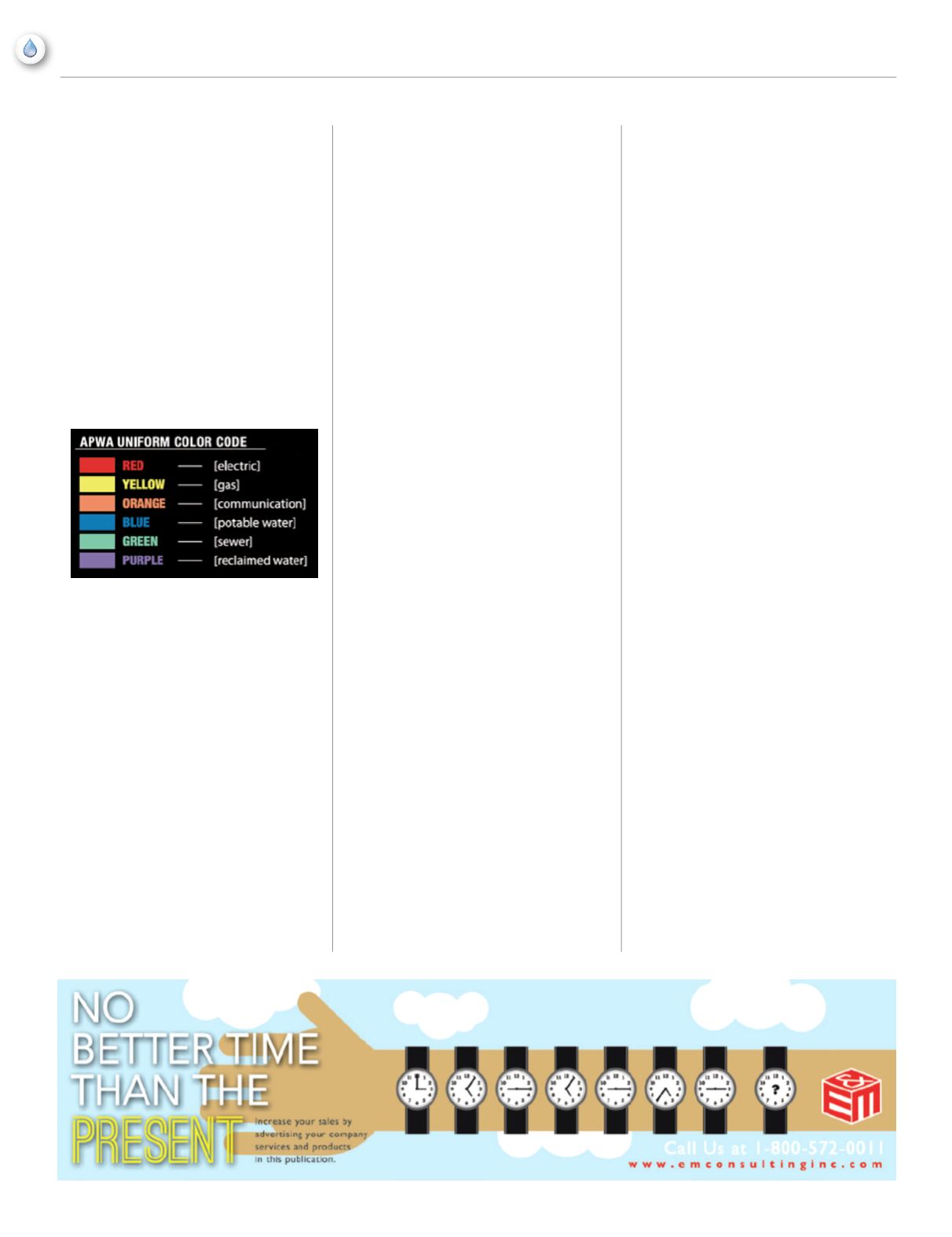
• Color Coding is simple, follow the APWA
uniform color code
• Many different jackets or coatings are
available. High Density Polyethylene
(HDPE) or High Molecular Weight
Polyethylene (HMWPE) are designed for
direct burial. Nylon or THHN, is not.
• Solid Copper or Copper Clad Steel (CCS)
work well and there’s no need for stranded
wire. High Strength Copper Clad Steel
(CCS) was introduced to the market in
2004 for tracer wire and it has a 2X strength
advantage over solid copper. Copper Clad
Steel has equal conductivity to solid copper,
but is usually less expensive.
• The best tracer wire in the ground, is
only as good as it’s connections. Proper
connectors, which protect from moisture
and corrosion, are extremely important.
Copperhead SnakeBite connectors and
3M DBR are two of the commonly used
moisture displacement connectors. One
should never twist the wires together and
merely wrap with electrical tape. Corrosion
will happen eventually and the locate signal
will be lost to ground at the connection.
• The tracer wire should be placed in the
same orientation to all installed pipe. Using
a spacer, taping the tracer wire to the pipe
every 8-10 feet in the three to six o’clock
position or specifying fill between the pipe
and tracer wire are all acceptable practices.
Taping the wire to the pipe helps prevent
damage to the wire during back filling or
when digging around the pipe in the future.
Installation of color coded warning tape
one foot above pipe will enhance utility ID
during excavation when repairs are needed.
Once tape has been found. Hand digging
should only be allowed
• The best tracer wire system is connected
with electrical current characteristics in
mind. Electricity will take the path of
least path resistance and shortest path to
ground. Good grounding and terminating
of the wire will improve quality of signal.
Using test stations to bring the tracer wire
above ground for ease of terminating a
signal is best. Grounding one or both ends
of the wire or introducing a small anode
may enhance signal strength.
• Different types of wire should be
considered for different installation
applications. Open ditch/direct bury does
not require as strong a wire as directional
drilling or pipe bursting. Consider
strength and coating type and thickness
when specifying wire, making sure there
will be no surprises after the project is
completed or when locating is required.
• Another very important step is to make sure
the contractor or city inspector performs
locate or conductivity test prior to signing
off on the project. It is much easier to
correct any issues promptly as opposed
to months or years later when locate is
required and the piping cannot be found.
Like your fire hydrant, curb stop, manhole,
piping and other important components of
your system, tracer wire should be taken just
as seriously. It’s ultimately an inexpensive
insurance policy. Especially if you weigh
the cost of repairs once a utility has been
damaged due to not being able to locate.
Write specifications to cover the entire tracer
wire system. Not just wire, but connectors,
test stations, and procedure as to how you
want the components installed.
The Minnesota Rural Water Association
recently adopted such an example specification
and installation instructions along with
drawings which can be viewed on their official
website here:
http://www.mrwa.com/PDF/TracerWireSpecGuideFinalweb3.pdf
If you would like more information including
example specifications, details, installation guides
to provide a more traceable system, please contact:
Brad Penley
Porter Associates, Inc
brad@porterassociates.com704-202-6429