11
Fall 2014 Issue
Safety & Workers’ Compensation
]
After an employee leaves you shorthanded by abandoning the
job early without permission, the last thing you want to see
is that employee granted unemployment for his/her actions.
There are a few facts about this type of situation that you
should be aware of to help prevent unemployment benefits
being awarded to the “job abandoner.”
When the Ohio Department of Job and Family Services
(ODJFS) reviews this type of claim, one question asked to the
employer is, “Did he/she attempt to return back to work within
a reasonable amount of time such as the next scheduled
shift?” If the answer is “yes”, ODJFS normally will not classify
this as a voluntary quit, but rather a discharge.
Under a discharge issue, ODJFS will ask the standard questions
about previous discipline/documentation and company policy.
Without previous documentation (ideally at least one written
warning) this will be viewed as an isolated incident. It will be a
difficult discharge claim for the employer to win. Company policies
are very helpful which state something similar to “immediate
termination will result if employee leaves a scheduled shift early
without permission” or “it will be considered a voluntary quit if
employee leaves a scheduled shift early without permission.”
Unfortunately even with a policy, it may not be enough to win
the claim without a prior documented incident. ODJFS may view
the policy/termination as being too harsh for this type of isolated
violation; a written warning may have been more suitable
following the incident.
You may decide that leaving the job early without permission
must be considered termination of employment due to the
difficulties it presents to the work environment. Then,
certainly proceed in the way that you feel is in the interest of
your business. As with any discharge issues, all circumstances
will be taken into consideration by ODJFS. Therefore, you
should explain in detail why this action had to result in the
employment ending.
Generally, three days of no-call, no-show will be treated by
ODJFS as a voluntary quit without the concern of ODJFS
classifying it as a discharge. Therefore, if he/she walks out and
does not make contact with the employer for three consecutive
days, this should be treated as a quit issue.
For additional information regarding unemployment tax rates, contact Kammy
Staton, CareWorks Consultants’ unemployment manager, at (800) 837-3200,
ext. 7165 or via email at
The Ohio Restaurant
Association (ORA) partners with CareWorks Consultants to offer a professional
unemployment compensation cost control program.
Employees Walking Off the Job Can
Lead to Frustrating Unemployment Claims
Follow these tips to help prevent a “job abandoner” from getting unemployment benefits
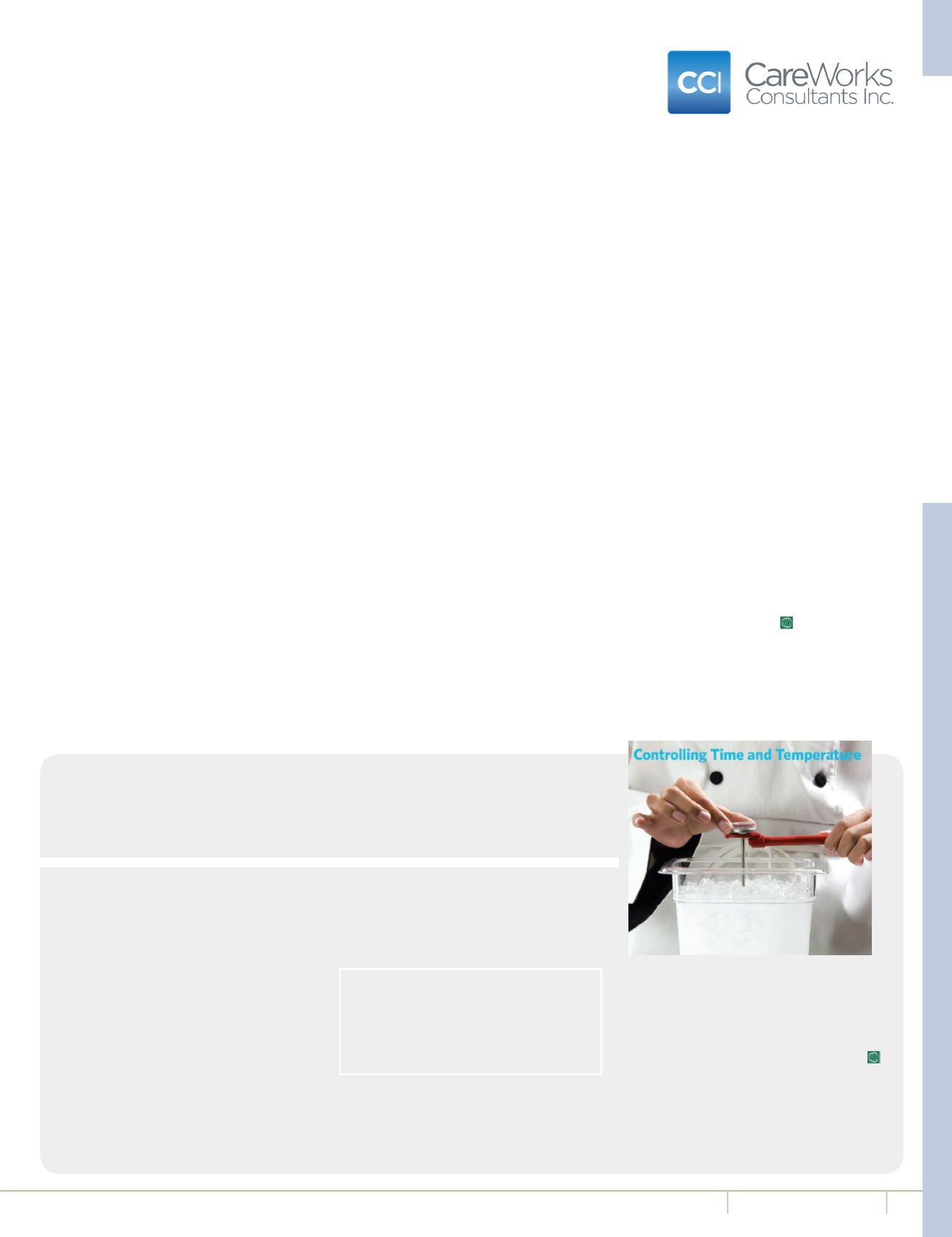
When you cook food that will not be
served immediately – for example, when
food handlers partially prep dishes early
to save time when they’re ordered – it’s
important to get the food out of the
“temperature danger zone” quickly.
The temperature danger zone is the range
between 41˚F and 135˚F (5˚C and 57˚C).
Harmful bacteria grow well in that zone. And
within that zone, bacteria grow even faster
between 125˚F and 70˚F (52˚C and 21˚C).
Food must pass through this temperature
range quickly to reduce this growth.
The general rule: Foods that need time and
temperature control for safety (TCS food for
short) must be cooled from 135˚F (57˚C) to
41˚F (5˚C) or lower within six hours.
Follow these guidelines:
• First, cool food from 135˚F to 70˚F (57˚C to
21˚C) within two hours.
• Then cool it from 70˚F to 41˚F (21˚C to 5˚C) or
lower in the next four hours.
If the food hasn’t reached 70˚F (21˚C) within
two hours, it must be reheated and then
cooled again. If you can cool the food from
135˚F (57˚C) to 70˚F (21˚C) in less than two
hours, you can use the remaining time to
cool it to 41˚F (5˚C) or lower. However, the
total cooling time cannot be longer than six
hours. Always be sure to check and comply
with your local regulatory requirements.
Visit ServSafe online at
for more
food-safety tips and to learn about the National
Restaurant Association’s (NRA) ServSafe Food
Safety Training Program. Members of the Ohio
Restaurant Association (ORA) receive a 15 percent
savings on ServSafe.
The Importance of Proper Food Cooling
Don’t let food linger in the “danger zone”


