20
Fall 2014 Issue
Safety & Workers’ Compensation
]
Produce has a strong health and nutrition correlation, but can
also be a “significant potential source of foodborne disease,”
according to Ecolab’s John Hanlin, who focuses on food
safety and public health. By examining and mitigating the
interconnected risks – customer/staff health risk, regulatory
risk, legal risk, and business/public image – operators can
approach produce strategically and build their reputation.
Last year at the National Restaurant Association (NRA)
Restaurant, Hotel-Motel Show, an expert panel covered
scientific facts regarding produce safety and offered helpful
tips any operator can put into practice to actively manage
produce safety and please guests.
Mitigate risk at every step of the supply chain
Many operators are faced with a complex supply chain for
produce. However, even farm-to-fork concepts can benefit
from revisiting where produce travels. Hanlin divides the
supply chain into “upstream” (growing, harvesting, washing,
cooling, sorting, packing, transport) and “downstream”
(holding, handling, washing, preparing and serving) to
identify key inspection points. Unfortunately, contamination
can happen anywhere based on mammals, birds, insects,
contaminated agricultural water, worker health and hygiene,
unsanitary equipment or tools, etc. Alex Malone, quality
assurance director for YUM! Brands, added that unlike other
food groups (e.g. meat, poultry, dairy, etc.), produce doesn’t
have a single processing step that can mitigate risk, so an
unyielding commitment to safety is key.
Inspect, test and validate every intervention you can
Malone offered a prime example of how every point along
a supply chain requires vigilance. All of YUM!’s produce
loads delivered from suppliers to distribution centers have
continuous temperature monitoring devices installed in every
truck of produce. Loads that don’t meet the requirements
are rejected upon arrival at the distribution center. With
inspection and testing, Malone advises: “Don’t be afraid of
cost – it may cost you everything [if you don’t]… [but] if we
all protect the consumer, we don’t have to worry about our
brands. That takes care of itself.”
Know your suppliers – and their suppliers
David Kramer, chef instructor at Culinary Arts College of
DuPage, physically inspects trucks when they arrive at his
back door. Having established standards and specs for what
he receives means he has a standard to which his suppliers
(and their suppliers) are held. You can go so far as to visit
vendors to inspect their facility; don’t simply rely on word of
mouth. Ask what systems are in place for traceability if and
when there is a product recall.
Build strategic alliances
With so much to keep track of, employees need to be coached
everyday on food safety basics, such as frequent hand-washing,
avoiding cross-contamination and the appropriate process for
handling produce. Sharing the rationale for such focus on
food safety (i.e. this keeps guests healthy and encourages a
positive association with the restaurant) will help employees
more readily understand why the protocol is important. In
addition, building a relationship with your health inspector
encourages him/her to be comfortable with your protocol and
lets you learn from what they see in their work elsewhere.
After all, health inspectors see the best and worst of what’s
out there.
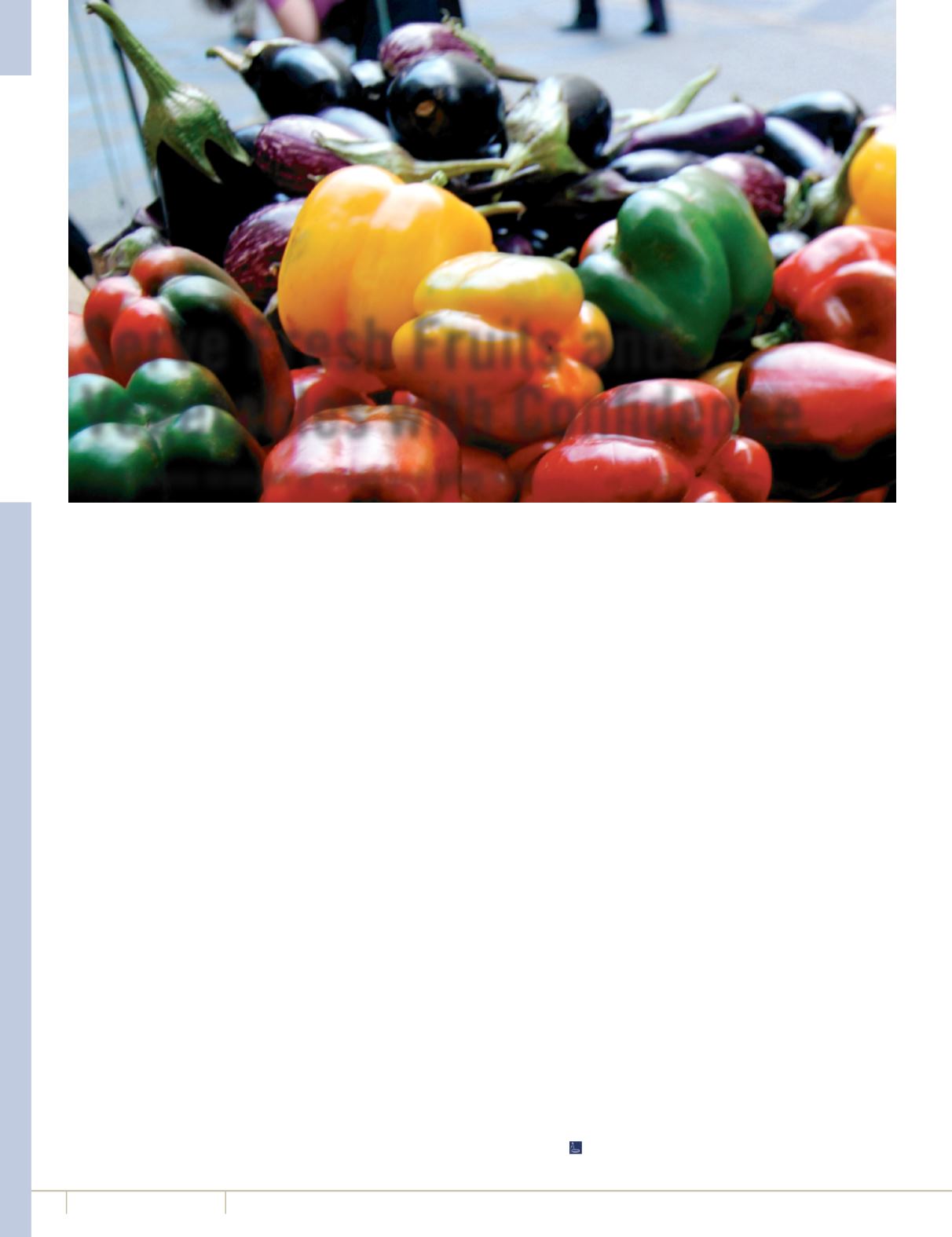
Serve Fresh Fruits and
Vegetables with Confidence
Utilize these strategies to reduce food safety risks


