18
Fall 2014 Issue
Safety & Workers’ Compensation
]
The most important time to impress a customer is when
they walk in the front door. Is your restaurant clean? If not,
customers may turn around and never come back. Beyond
this, what invisible threats may be lurking in a seemingly
clean environment? These are issues that can impact the
future of your business.
That’s why there needs to be just as much effort spent on
cleaning and sanitizing the front-of-the-house as there is in the
back-of-the-house. The risks of a poor inspection report from
the health inspector, or worse, a cross-contamination incident
are just too high to ignore. A patron contracting a foodborne
illness at your establishment can put you out of business.
In the front of the house, surfaces should be cleaned with
each table turn. What is cleaned should be based on what
patrons typically touch during their visit to the restaurant.
Examples include tables, chairs, and menus. Any surface
that comes in direct contact with food, such as high chair
trays, must also be sanitized.
HERE ARE FIVE STEPS FOR PROPERLY
CLEANING AND SANITIZING SURFACES:
1. Remove food from the surface:
Removing food bits and
spills before washing the surface will help the cleaner
work better. Use a disposable paper towel or disposable
cloth that can adequately pick up a majority of the
liquid or food particles.
2. Wash the surface:
Washing the surface removes any
remaining food or other dirt. Care should be used
in choosing the right cleaner as some may damage
surfaces. Consider disposable wipes that are chemically
treated to keep the wiper fresh by limiting the growth of
odor-causing bacteria.
3. Rinse the surface:
Rinsing with water removes the
cleaner from the surface. This is important to prepare
for the sanitizing step. Any cleaner that remains on a
surface may reduce the effectiveness of the sanitizer.
4. Sanitize the surface:
Sanitizing reduces viruses or bacteria
that may remain on the surface to safe levels. This step,
often overlooked, is crucial as it reduces the risk of
cross contamination. The typical tools for sanitizing are
quaternary ammonium compounds—or quats for short,
and chlorine-based sanitizers. SCA recommends that
a foodservice wiper or cloth that helps distribute the
sanitizer on the surfaces should also be used. Paper or
absorbent cloths are not well-suited for this task, as they
will absorb the sanitizer and not allow it to remain on
the surface. Disposable wipes designed to pro-long the
effectiveness of sanitizing solution are optimal.
5. Allow the surface to air dry:
Air drying seems trivial.
However, this is the most important step of sanitizing. In
order for a sanitizer to work, it must stay in contact with
the surface for a specific amount of time. Allowing the
surface to air-dry will ensure it has enough time to do
this. Cross-contamination may also be prevented if the
surface is air-dried instead of being towel-dried.
Proper cleaning and sanitizing will help address both the
perceived cleanliness of the establishment by patrons as well
as the actual cleanliness, so customers will be happy to walk
through your front door time and time again.
This article from the National Restaurant Association (NRA) was provided to
the Ohio Restaurant Association (ORA) for use and was composed by Suzanne
Cohen, a foodservice director at SCA AfH Professional Hygiene. Cohen
shared her insights on cleaning and sanitizing as an expert in the foodservice
segment who leads industry-specific marketing solutions and strategy
development for her company. Her passion is understanding actionable
consumer insights that fuel growth. SCA, a global hygiene company and
makers of the Tork
®
brand away-from-home paper products, which sponsored
this year’s National Food Safety Month for the fourth consecutive year.
Here are five simple steps for properly cleaning and sanitizing surfaces
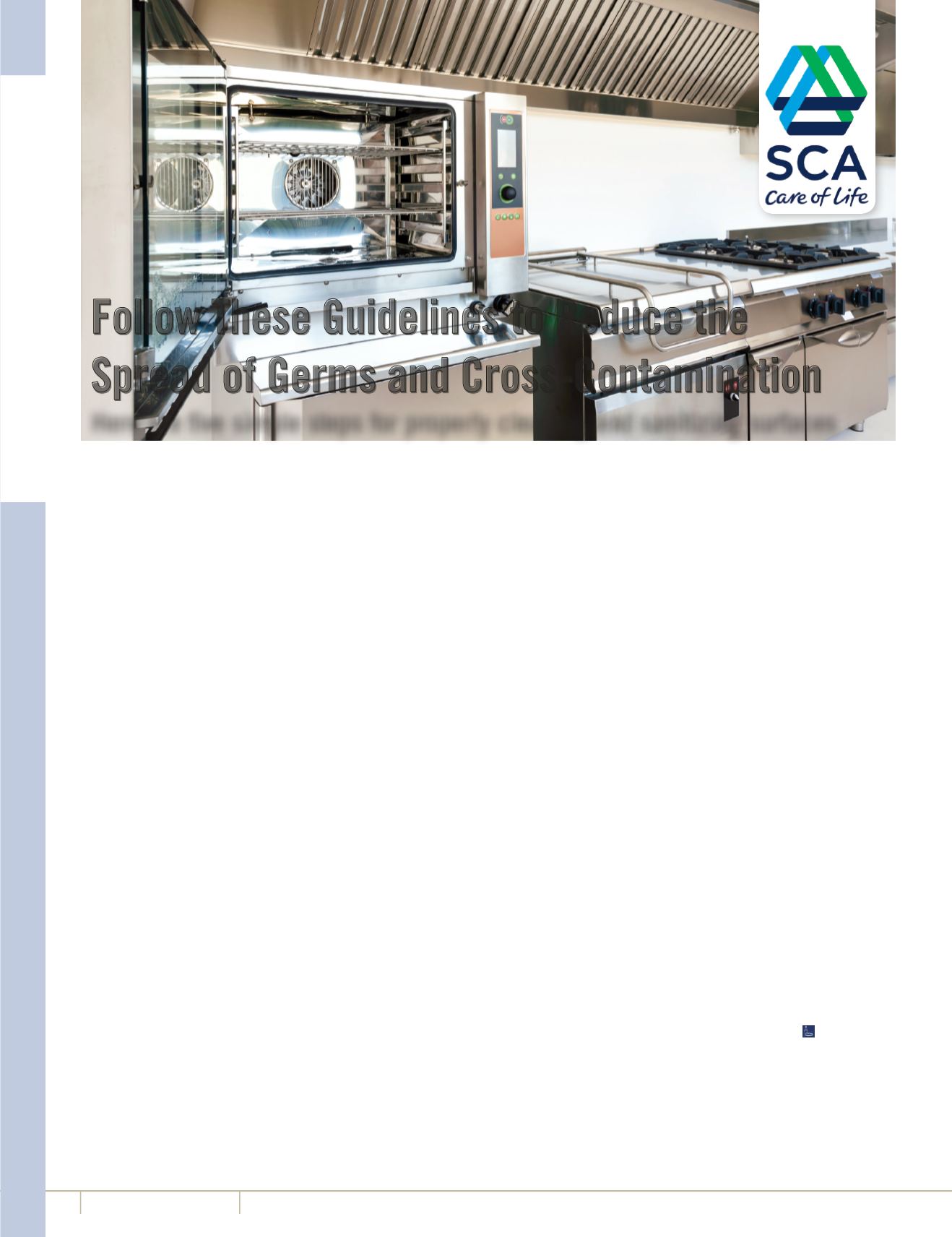
Follow These Guidelines to Reduce the
Spread of Germs and Cross-Contamination


